Picture this: You are scrolling on your phone, dreaming of neon lights and buffets, and you find a killer $49-a-night deal on a beautiful Las Vegas Strip hotel. You are thrilled. You click to book, start mentally packing your bags, and then you see the final bill at checkout. Suddenly, that amazing nightly rate has doubled.
Welcome to the confusing, often frustrating world of Las Vegas resort fees.
If you have ever felt completely caught off guard by these extra costs, you are definitely not alone. Many people book a room thinking they scored the ultimate bargain, only to discover that the resort charges Las Vegas hotels tack onto the bill completely change the true cost of their vacation. It is a common pain point that leaves plenty of folks feeling like they just lost a hand of blackjack before they even stepped foot on the casino floor.
In this comprehensive guide, we are going to break down everything you need to know about these mandatory extras. We will explain exactly what they include, dive into the legality of it all, and share practical, actionable strategies for dodging or minimizing them. Whether you are planning a quick weekend getaway, a family vacation, or looking for an affordable spot to rest your head, knowing how to spot and handle a Vegas resort tax or fee is the first step to becoming a truly savvy traveler.
By staying informed and looking at the full financial picture, you can focus on what really matters: having an amazing time, relaxing, and knowing you scored a genuinely great deal.
- Book your Las Vegas hotel today with Super.com & save up to 40%!
- Want more savings? Book using Super+ for exclusive membership rates.
What Exactly is a Las Vegas Resort Fee?
When you are looking at your booking details, it is easy to wonder what exactly constitutes a Las Vegas resort fee. In simple terms, a resort fee is a mandatory daily charge that a hotel adds to your base room rate. It is designed to cover a bundle of specific amenities and services that the property provides during your stay. However, the reason these fees cause so much confusion is that they are almost always excluded from the headline room rate that first grabs your attention.
To really understand how these resort fees actually work, we have to look behind the curtain at why they exist in the first place, how different websites display them, and what perks you are supposedly getting for your hard-earned cash.
Why am I charged a resort fee?
The most common question frustrated travelers ask is, “Why am I being charged a resort fee?” The answer comes down to how the hotel and travel industry operates online. Hotels want their properties to show up at the very top of your search results when you are hunting for a bargain. To do this, they advertise a remarkably low base room rate. It looks fantastic on screen. But to protect their profit margins and cover their operating costs, they take a portion of what they need to earn and label it as a separate, mandatory daily fee.
Because the fee is mandatory, you cannot simply opt out of it, even if you never intend to use the swimming pool or log onto the internet. The hotel relies on this split-pricing model to stay competitive in initial searches while still making the money they need to run those massive, glittering resorts. It is a pricing strategy that has been a staple in Las Vegas for over a decade, and it is the primary reason why it is absolutely essential to look at the total estimated cost of your stay, rather than just the initial advertised nightly rate.
Do Resort Fees Vary by Booking Platform?
Another massive point of confusion is whether you can avoid these fees simply by booking on a different website. The straightforward truth is that the actual fee amount is entirely fixed by the hotel. If a famous property on the Strip charges a $50 daily resort fee, that fee is $50 whether you book directly with them, use a massive online travel agency, or find a deal on a different platform.
However, third-party sites handle the display of these fees very differently, which is where things get tricky. Hotels have to pay travel websites a commission on the base room rate, but they generally do not pay a commission on the resort fees. Because of this, hotels vastly prefer that you pay the fee directly to them at the front desk. This dynamic is exactly why many booking sites might show you a cheaper upfront rate when you hit search, but later tack on a disclaimer stating that a mandatory fee is due at the property.
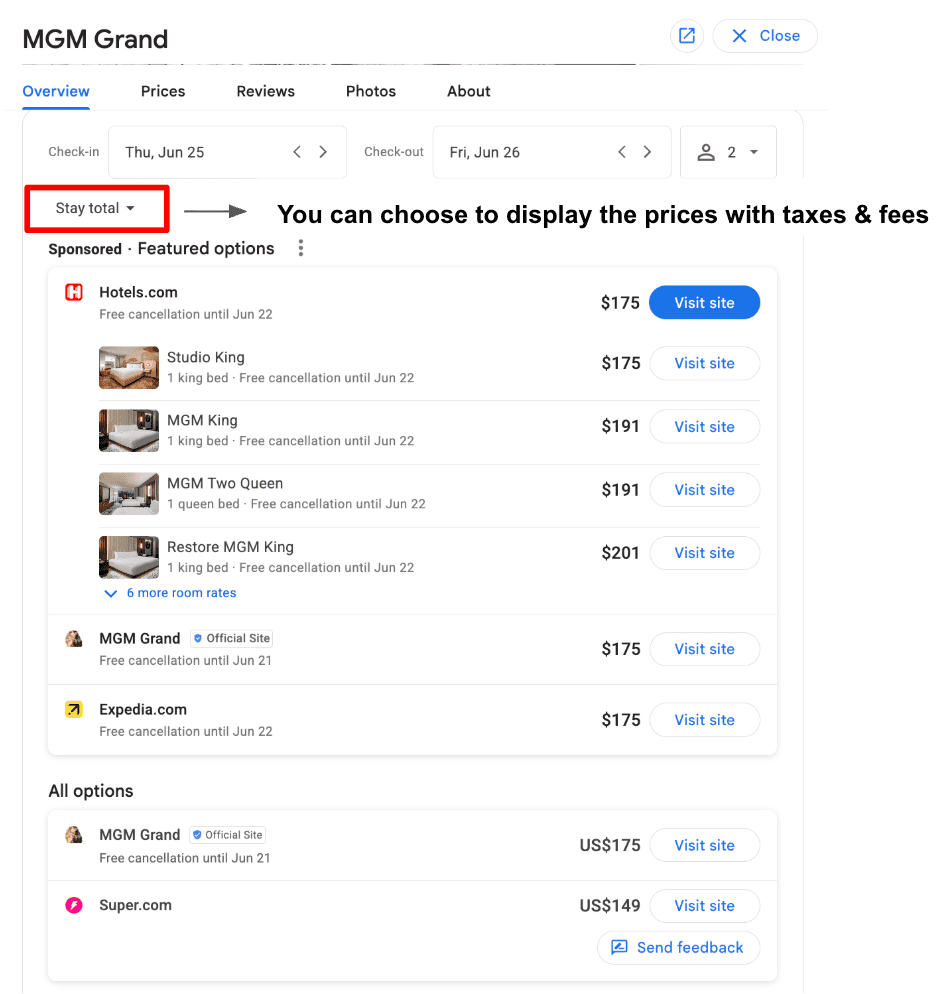
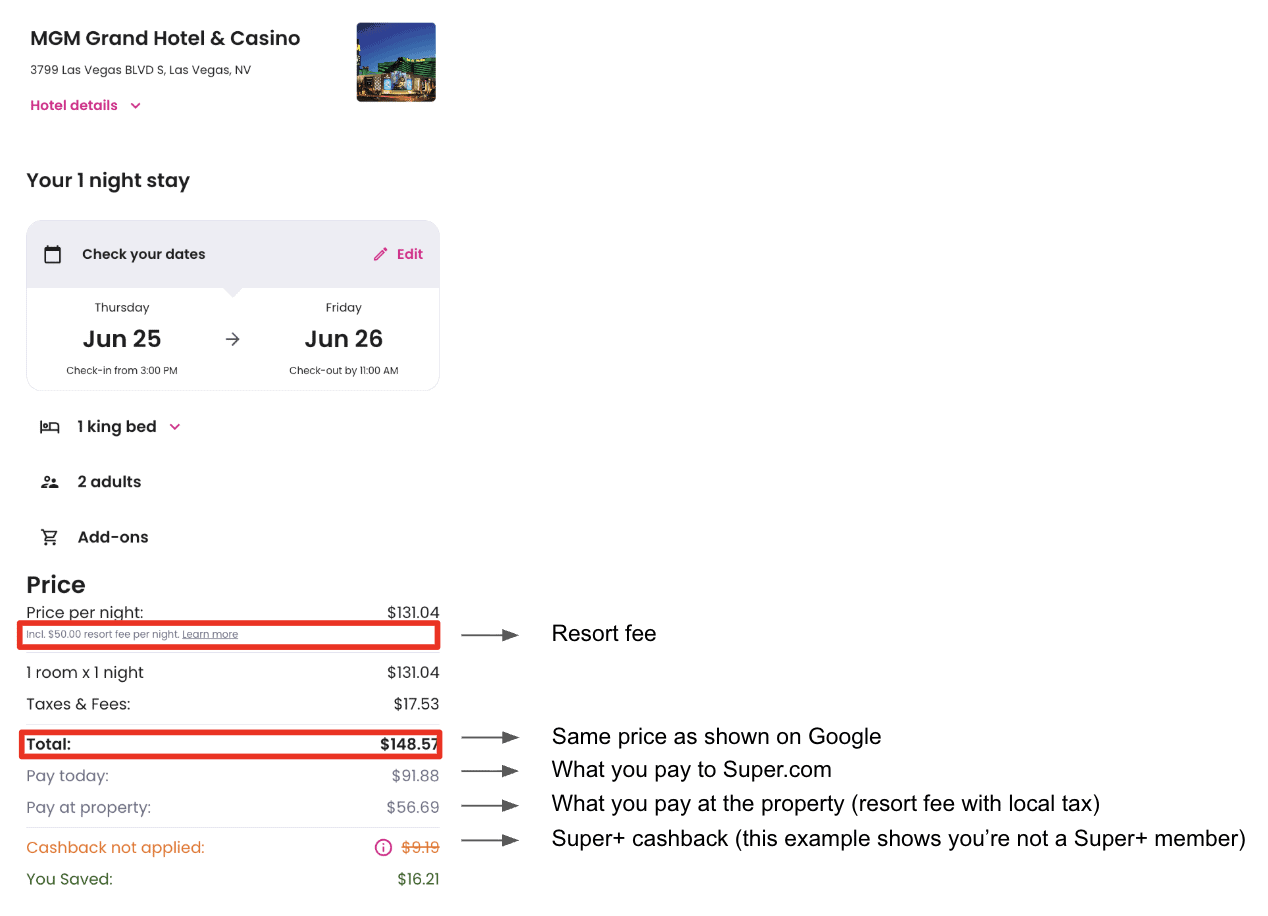
At Super.com, we believe in making sure you can see the full picture before you commit to booking. When you discover our Las Vegas hotel rates via Google Travel, we display the all-in pricing. What you see on Google should match what you see in our booking flow. Fee transparency means you can clearly see what you pay today to secure your room, what you will pay at the property when you arrive, and the total stay cost. We separate the “pay now” amount from the “due at property” amount at checkout. We do not set the resort fee, the hotel does but we want to ensure you have the full math in front of you. When you see language noting that a fee is payable at the hotel or front desk, it helps clarify exactly where your money is going and prevents the feeling of being charged twice.
By presenting a crystal-clear price breakdown, we help you stick to your budget, dodge surprise costs, and book with total confidence. The deal you see is the deal you get, and you’re free to spend less time stressing over math and more time planning those iconic neon nights and bottomless buffets. After all, we’re here to help you save every step of the way because when you win, we all win.
What is included in a resort fee?
So, what exactly are you buying with these resort charges Las Vegas hotels require? To justify the mandatory extra cost, hotels bundle together a variety of property amenities. While these perks can occasionally add value if you plan to use them, for many travelers, they represent services they might not need.
Here is a breakdown of the typical “perks” properties claim to provide:
- In-room Wi-Fi: This is the most common inclusion. However, be aware that it is often limited to a certain number of devices (usually two to four) and might only cover standard-speed internet access. If you need high-speed internet for work or streaming, you might still face an upcharge.
- Fitness center access: While it sounds great to hit the gym, the fee typically just gets you through the door. Special classes or personal training sessions will cost extra.
- Local phone calls and boarding pass printing: In the era of smartphones and digital airline tickets, these are arguably the least utilized benefits, but they remain standard inclusions on almost every property’s list.
- Pool access: Your fee generally covers your entrance and the use of basic lounge chairs. However, cabanas, daybeds, and sometimes even premium seating areas require separate, often hefty, rental fees.
- Miscellaneous extras: Depending on the property, you might also get a daily newspaper (often digital via apps like PressReader), in-room coffee, two bottles of water upon check-in, or free notary services.
How much is the resort fee in Vegas?
You can expect a fairly wide range when it comes to the resort fees. On the more budget-friendly end of the spectrum, particularly at older off-Strip properties or downtown hotels, you might see fees ranging from $15 to $25 per night.
As you move onto the main Las Vegas Strip, the numbers climb quickly. Mid-tier hotels frequently charge between $35 and $45 per night. If you are staying at a luxury resort—think massive complexes with elaborate fountain shows, high-end shopping, and massive pool decks you can fully expect to pay between $45 and $55 or more per night.
It is also incredibly important to remember the Vegas resort tax. Yes, resort fees are subject to local taxes! This means a $50 per night resort fee will often display as something like $56.63 on your final checkout screen or at the front desk because the applicable Las Vegas taxes are added directly on top of the base fee. Always mentally add a few extra dollars to the advertised fee to account for the local tax rate.
Can You Refuse to Pay Resort Fees?
This is the ultimate question for any budget-savvy traveler. If you do not plan on using the gym, connecting to the Wi-Fi, or swimming in the pool, can you simply opt out? It is a logical question, especially when you are looking to save every possible dollar.
Can you refuse to pay resort fees in Las Vegas?
The short answer is: Generally, no. You cannot simply refuse to pay them just because you do not want to use the amenities. When you book the room, the terms and conditions state that the fee is a mandatory contractual obligation upon check-in. The hotel relies on this revenue as part of its core pricing model, so the front desk staff typically has zero authority to just wave the fee away because you have your own unlimited data plan.
That being said, there are rare exceptions where you might have grounds to contest them. If the amenities that the fee explicitly covers are entirely broken or unavailable during your stay for instance, if the entire pool complex is closed for emergency maintenance in the middle of summer, and the hotel’s Wi-Fi network goes down for your entire trip—you can politely speak to a manager. In these specific cases of service failure, a hotel might agree to a partial or full waiver of the fee for the days affected. But this is strictly a customer service remedy for broken amenities, not a loophole for everyday travelers.
How to Minimize Resort Fees in Las Vegas (Actionable Strategies)
Just because these fees are generally mandatory does not mean you are entirely without options. If you are determined to keep your travel costs as low as possible and avoid feeling nickel-and-dimed at checkout, there are a few proven, practical strategies you can employ.
Strategy 1: Match Your Gambling Status
If you visit Las Vegas frequently or participate in local casino loyalty programs back home, your player’s card might be your golden ticket. The two major players on the Strip, Caesars Entertainment and MGM Resorts, offer resort fee waivers as a core perk for their higher-tier loyalty members. For Caesars Rewards, achieving Diamond status or above eliminates the fee. For MGM Rewards, reaching Gold status or higher does the same. Even if you do not gamble much, some premium travel credit cards offer status-matching programs that can automatically bump you up to these tiers.
Strategy 2: Stay at No-Fee Hotels
The easiest way to avoid a resort fee? Book a hotel that proudly skips them altogether. Honest, upfront pricing still exists—yes, even in Las Vegas. One favorite right on the Strip is the Best Western Plus Casino Royale: zero resort fees, no hidden charges, and all the essentials covered. Free WiFi, free parking, and a location smack in the middle of the action—it’s practically a unicorn.
Looking a bit off the Strip? Marriott’s Grand Chateau also ditches daily resort fees. It’s perfect for travelers who want a quieter, non-casino vibe but still want to be just a 15-minute walk from the Strip. Or try Desert Rose Resort for a suite-style stay without a casino atmosphere or those extra fees—just a couple of blocks from all the bright lights. Club Wyndham Grand Desert is another strong pick, offering no resort fees, apartment-style accommodations, and plenty of amenities (think pools, kitchens, and free shuttles to the Strip).
There you have it—a handful of Las Vegas hotels that keep it simple and straightforward, with no resort fees to surprise you at checkout. Want more options? A quick search for “no fee hotels in Las Vegas” will open up even more wallet-friendly choices (because we know every dollar counts).
| Las Vegas Hotels Without Resort Fees | Average Super.com Nightly Rate | Description |
| Best Western Plus Casino Royale | ~$180 | Located on the Las Vegas Strip, Best Western Plus Casino Royale – Center Strip is 1 mi away from Sands Expo and Convention Center. |
| Marriott’s Grand Chateau | ~$328 | Located 15 minutes’ walk from the Las Vegas Strip, this non-gaming and nonsmoking hotel offers air-conditioned rooms with free WiFi for all devices. |
| Desert Rose Resort | ~$155 | Desert Rose Resort is less than 2 blocks from the Las Vegas Strip but avoids a casino atmosphere. |
| Club Wyndham Grand Desert | ~$760 | This resort is a 5-minute walk from the Las Vegas Strip. It offers 3 outdoor pools and free shuttles to the Strip. |
Strategy 3: Use Super+ membership
When you cannot avoid the fee, the next best strategy is to offset the cost. This is where a Super+ membership comes in incredibly handy. By utilizing the 10% cashback offered on bookings through the membership, you can earn back a significant portion of what you are spending. If you book a multi-night stay, the cashback you earn can essentially cover the cost of the resort fee you have to pay at the property. It is all about finding ways to put money back in your pocket, making sure you get the best possible value out of your trip without sacrificing comfort or convenience.
Conclusion & Summary Checklist
Las Vegas resort fees are frustrating primarily because they are mandatory and so often excluded from the headline room rate that first catches your eye. The real trick to navigating them is knowing whether the travel site you are using shows that fee clearly before you hit the book button. At Super.com, we make a point to separate what you pay right now from what you will owe at the hotel, empowering you to evaluate the true total cost before you complete your reservation.
When you are budgeting for Sin City, always calculate the total cost, including the daily fee and the Vegas resort tax. Do not let the upfront price tag fool you.
Before you book your next trip, keep this quick 3-point summary checklist in mind:
- Check the “Due at Property” Amount: Always look past the headline nightly rate and locate the specific amount marked as payable at the hotel or front desk.
- Factor in the Taxes: Remember that a $45 fee will actually cost you over $50 once local Las Vegas taxes are applied.
- Look for Offsets: Check if you have loyalty status that waives the fee, look into no-fee properties, or use cashback rewards from programs like Super+ to balance out the extra charges.
Frequently Asked Questions (FAQ)
A resort fee is a mandatory nightly charge added to your hotel room rate by the property. It is designed to cover specific amenities like Wi-Fi and fitness center access. Crucially, you must pay this fee even if you do not use any of these amenities.
On the Las Vegas Strip, resort fees generally range from $30 to $50+ per night (plus tax) at major resorts.
Yes, but they are becoming rare. A few notable properties that do not charge resort fees include: Best Western Plus Casino Royale, Marriott’s Grand Chateau, Desert Rose Resort, and Club Wyndham Grand Desert.